
DIY vs Professional Christmas Light Installation
An honest comparison — what you actually save doing it yourself, what you give up, and the three situations where hiring someone is clearly the right call.
Call or text (707) 343-4469 Get a Free Quote
- Veteran owned
- Family run
- Napa local
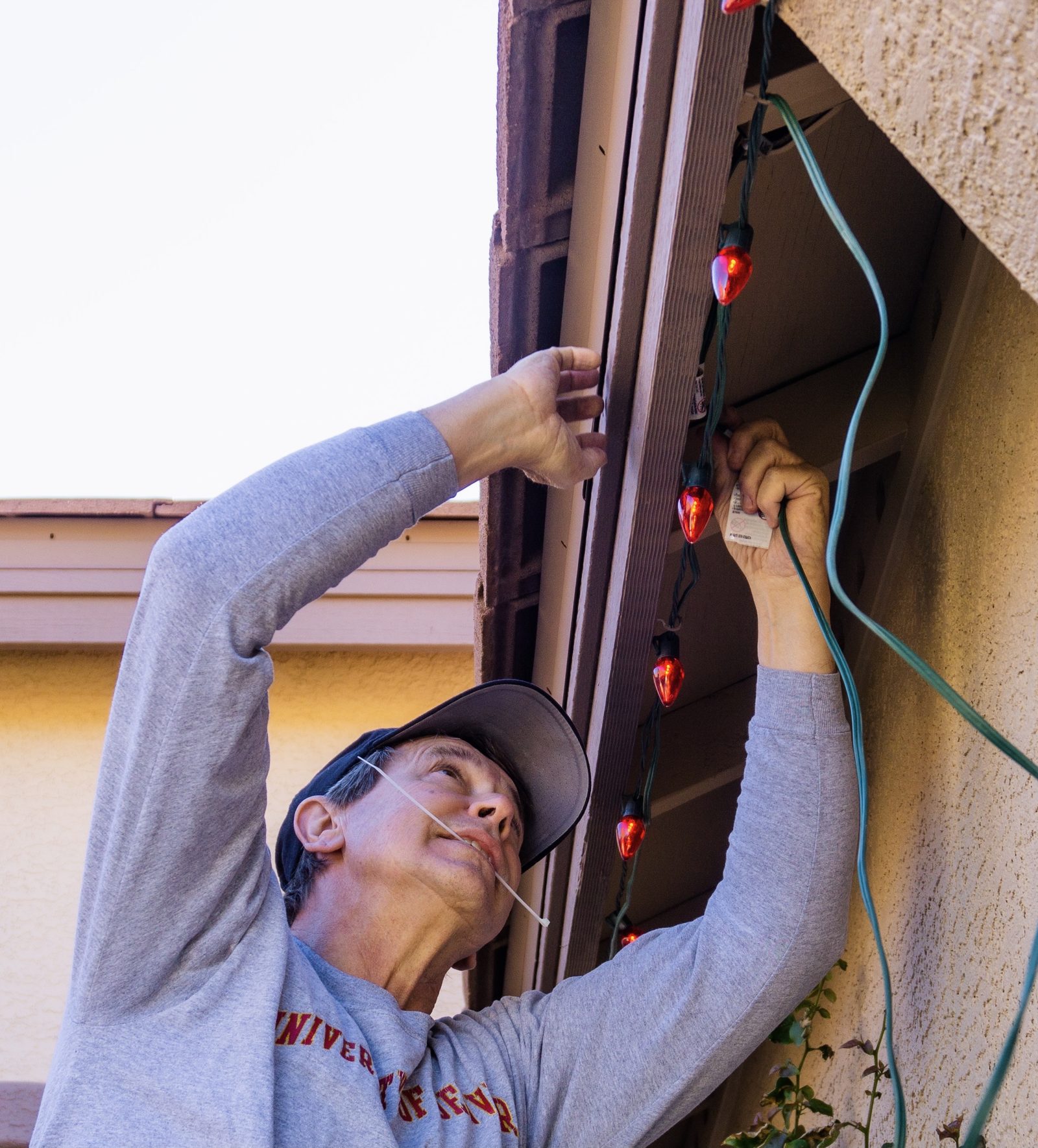
Plenty of people should put up their own Christmas lights. If you have a single-story house with an accessible roofline, a decent ladder and a free Saturday, doing it yourself is entirely reasonable and we would rather say that than pretend otherwise.
This page is about where that stops being true.
What you genuinely save
Year one, DIY is cheaper. Retail C9 sets run roughly $30 to $60 per 25-foot string, so a 200-foot roofline is around $250 to $450 in materials, plus clips and a timer. A professional install of the same roofline is $600 to $1,200.
The gap narrows fast though. Retail sets typically last two to three seasons before enough sockets fail to make a run unreliable, so you are re-buying regularly. Professional installs use commercial-grade components rated for many more seasons, and when the sets are leased with the install you never replace anything.
What actually differs in the result
- Custom-cut versus fixed lengths. This is the whole visual difference. Retail sets come in fixed lengths, so DIY runs double up at one corner and go dark at another. Professional socket wire is cut to your measured roofline, so spacing is even the whole way.
- Consistent color temperature. Buy warm white sets from two batches and you will see it from the street. Professional bulbs come from one lot.
- Weatherproofed connections. Sealed junctions and drip loops. Water finding a connector is the single most common cause of a display dying in December, and it is the thing DIY installs almost never account for.
- Correct clips per surface. Gutter lip, shingle edge, tile edge and fascia all need different clips. Most DIY installs use one type everywhere, which is why runs sag by mid-December.
- Somebody else does January. The part everyone underestimates.
Three situations where you should not DIY
- 1. You have a tile roof. This is the big one in Napa. Clay and concrete tile crack under body weight, and a cracked tile is a leak path that shows up in the first February storm — long after the lights are down, and nobody connects the two events. A $400 DIY project becomes a roof repair. If your roof is tile, either hire someone who works from the perimeter or light the trees and entry instead and leave the roof alone.
- 2. Anything above single-story reach. Ladder falls are the injury in this trade, and December roofs are wet. If a section needs an extension ladder at an awkward angle, the honest calculation is not about money.
- 3. You will not want to take them down. Be truthful about this one. If January-you will leave them up, DIY has a hidden cost: UV destroys cable through a Napa summer, and degraded wiring sitting in defensible space through fire season is exactly what nobody here wants on their house.
If you are doing it yourself, do these five things
- Measure first. Walk the roofline with a tape before buying anything. Almost every bad DIY display is a length problem.
- Buy one brand, one batch, one color temperature. Mixed warm whites are the most common giveaway.
- Use the right clip for the surface, and never a staple gun. Staples pierce cable insulation, which is both a failure point and a hazard.
- Make drip loops. Let cable hang below every connection so water runs away from the junction rather than into it. This one habit prevents most December failures.
- Use a GFCI-protected exterior outlet and a photocell timer. Do not run a chain of indoor extension cords out of a window.
📞 Call or text (707) 343-4469 if you would rather not spend the Saturday on a ladder. Get a Free Quote
Common questions
Is it much cheaper to do it myself?
What is the single biggest difference in how it looks?
I have a tile roof. Can I do it myself carefully?
Why do my lights always fail partway through December?
Can you install lights I already own?
Is it worth hiring someone just for takedown?
What about renting versus buying the lights?
How long does a DIY install usually take?
📞 Call or text (707) 343-4469 and we will give you a firm price to compare against. Get a Free Quote